
Bring your own vector store: LlamaCloud Index V2 → Azure AI Search
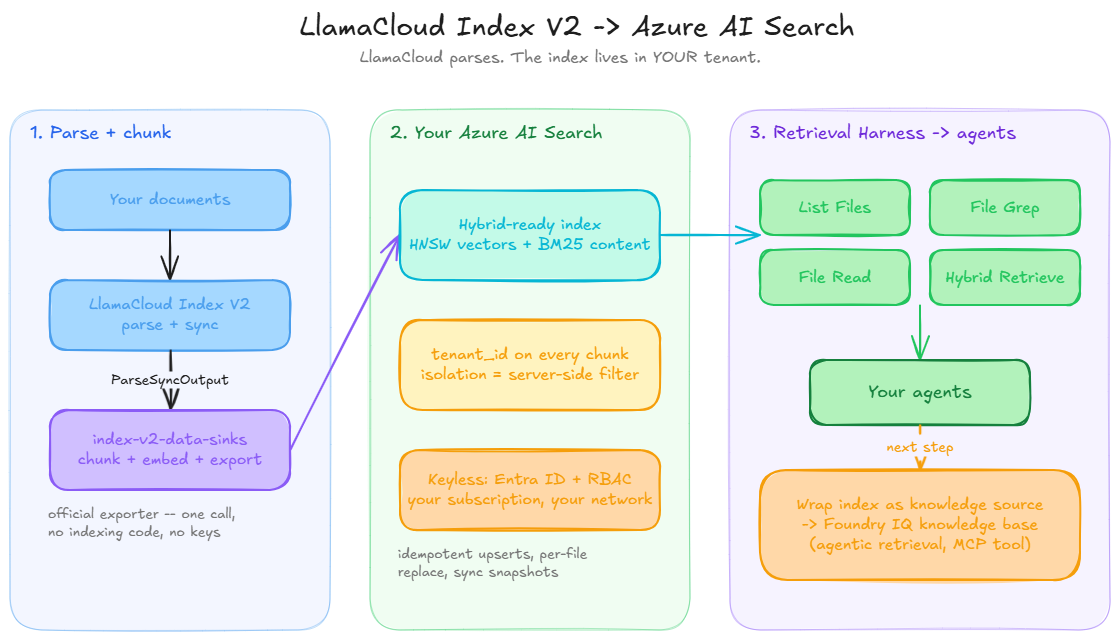
LlamaCloud parses; you choose where the result lives. Land LlamaCloud-parsed documents in your
own Azure AI Search index using the official
index-v2-data-sinks exporter — one call and no
indexing code — then query it with LlamaIndex Retrieval Harness primitives your agents can use.
This cookbook builds on the official LlamaIndex ↔ Azure AI Search integration and extends it to LlamaCloud's Index V2 export path.
| Difficulty | Intermediate |
| Time to complete | ~15 min |
| Est. cost | ~$0 incremental if you already run an Azure AI Search service (a few dozen small embedding calls; the demo index is deleted at the end). A dedicated Basic service is ~$75/mo if you create one just for this. |
What you'll build, and why it matters
LlamaCloud's Index V2 splits two things that vector databases usually weld together:
parsing (turning messy PDFs/HTML into clean, page-aware markdown) and storage (where the
embedded chunks live). Index V2 does the parsing and sync; the official index-v2-data-sinks
package lets you send the result to a store you own.
By the end you'll have run the Azure AI Search sink end-to-end against your own service — using Entra ID rather than Azure service keys — verified the scope fields the exporter writes, and layered LlamaIndex Retrieval Harness primitives (List Files, File Grep, File Read, Hybrid Retrieve) on top. Every claim below is checked with an assertion as the notebook runs.
Why Azure AI Search as the sink (the customer value):
- Your data stays in your tenant. Chunks and vectors land in your Azure AI Search — your
subscription, your network, your Entra ID identities and RBAC — not a third-party managed index.
Access is governed by Azure RBAC on the service; the exporter additionally stamps
tenant_idandexport_config_idon every chunk so queries can be scoped server-side (see Step 4 for what that does and does not guarantee). - Zero indexing code to write or maintain. The sink auto-provisions a hybrid-ready index (HNSW
vectors + a searchable
contentfield), writes deterministic document keys, does idempotent upserts, per-file replace, and exposes incremental-sync snapshots. You call one function. - One step from agentic retrieval. An index landed here can be wrapped as a knowledge source and queried by an Azure AI Search knowledge base — query decomposition, parallel subqueries, semantic reranking, and grounded answers. This gives Azure AI Search a documented path from exported chunks to Foundry IQ agentic retrieval.
- Reuse what you already run. Land LlamaCloud-parsed content next to everything else in Azure AI Search and query it with the same security, hybrid ranking, and tooling — no new datastore to buy, secure, or operate.
- Agent-ready by construction. Because the exported index keeps
parsed_directory_file_idandcontent, it doubles as a filesystem-style surface agents can List / Grep / Read — not just a fuzzy semantic search box.
Prerequisites
Python 3.11–3.13 — the pinned
index-v2-data-sinkscommit declaresrequires-python = ">=3.11,<3.14", so 3.14 is not supported.An Azure AI Search service. Any tier works for this demo; hybrid + semantic ranking on your own data wants Basic or higher.
An Azure OpenAI (Microsoft Foundry) embedding deployment. This recipe supports
text-embedding-3-large(3072-dim, default),text-embedding-3-small(1536-dim), ortext-embedding-ada-002(1536-dim).Keyless auth (the default path): run
az login, then assign these roles to your own identity (not to the service):- On the search service:
Search Service Contributor(create/delete indexes) andSearch Index Data Contributor(write and query documents) - On the Azure OpenAI resource:
Cognitive Services OpenAI User
This notebook calls the direct
/openai/v1endpoint, soCognitive Services OpenAI Useris sufficient for embeddings.Foundry Useris required only when you call a Foundry project endpoint for Foundry SDK, agents, or project tools.Role assignments take a few minutes to propagate — a
403immediately after assigning is usually not a misconfiguration. Wait and retry.- On the search service:
~15 minutes. The demo index is deleted at the end, so incremental cost is negligible.
Set these in your shell or a local .env next to this notebook (the repo .gitignore excludes .env):
SEARCH_ENDPOINT=https://<your-search-service>.search.windows.net
AOAI_ENDPOINT=https://<your-foundry-resource>.openai.azure.com
AOAI_EMBEDDING_DEPLOYMENT=<your-deployment-for-large-small-or-ada-002>
SEARCH_API_KEY=      # optional fallback ONLY if you can't get RBAC — leave unset for keyless
AOAI_API_KEY=        # optional fallback ONLY if you can't get RBAC — leave unset for keyless
Keyless for the Azure services used here. No Azure API key value is embedded in this notebook: leave the key variables unset and the sink uses
DefaultAzureCredential, so the Azure write path runs on your Entra ID identity. The productionexport_pipelinepath is a separate matter — it still needs aLLAMA_CLOUD_API_KEYand credentials for whichever embedding provider you configure.
Setup
Pinned to an exact commit — index-v2-data-sinks ships from GitHub (not PyPI) and has no releases,
so an unpinned install would drift the moment the repo moves. The Azure SDKs are pinned explicitly
rather than left to the sink's >= floors. The install runs unconditionally so a previously
installed revision can't silently change the behavior you see below.
%%capture
# Installed unconditionally rather than behind a `try: import ... except ImportError`
# guard: a different revision already present in the environment would otherwise
# shadow the pinned commit, and you'd be reading results this recipe never verified.
# `--upgrade` makes pip re-resolve the direct git reference instead of keeping
# whatever is already installed. The pinned commit declares requires-python ">=3.11,<3.14".
%pip install --quiet --upgrade "index-v2-data-sinks@git+https://github.com/run-llama/index-v2-data-sinks@798cac7e25f7485aa78b5f666957af41cae62c2f" "azure-search-documents==12.0.0" "azure-identity==1.25.3" "openai==1.109.1" "beautifulsoup4==4.13.3" "python-dotenv==1.2.2"
Configuration — the only cell you edit
Every knob lives here, named, so the rest of the notebook has no magic numbers. This is the cell the copy-paste reader changes and nothing else.
# --- Configuration ---------------------------------------------------------
# Index naming. The sink provisions ONE index per embedding model; the default
# model keeps the base name, others get a sanitized suffix.
#
# The prefix carries a short random suffix so this demo always creates its OWN
# index. A fixed, predictable name would let this notebook delete an index that
# an earlier run — or a colleague on the same service — is still using.
import uuid

RUN_ID = uuid.uuid4().hex[:8]
INDEX_PREFIX = f"forgebook-index-v2-sink-{RUN_ID}"

# Which model the sink sizes the index for. The Azure OpenAI deployment configured
# below must be the same base model, or query-time vectors and the index dimension will diverge.
EMBEDDING_MODELS = {
    "openai:text-embedding-3-large": 3072,
    "openai:text-embedding-3-small": 1536,
    "openai:text-embedding-ada-002": 1536,
}
EMBEDDING_MODEL = "openai:text-embedding-3-large"  # Change this with your deployment.
EMBEDDING_DIM = EMBEDDING_MODELS[EMBEDDING_MODEL]
AOAI_API_VERSION = "2024-10-21"   # Azure OpenAI data-plane api-version
EMBED_BATCH = 16                  # chunks embedded per Azure OpenAI call


def sink_index_name(prefix, embedding_model):
    """Match the official sink's one-index-per-model naming convention."""
    if embedding_model == "openai:text-embedding-3-small":
        return prefix
    suffix = embedding_model.replace(":", "-").replace("/", "-").replace(".", "-").replace("_", "-").lower()
    return f"{prefix}-{suffix}"


INDEX_NAME = sink_index_name(INDEX_PREFIX, EMBEDDING_MODEL)

# How the sink chunks each document: "fast" | "sentence" | "token".
CHUNK_STRATEGY = "sentence"

# Tenant + export-config labels written onto every chunk. In production these are
# your LlamaCloud project id and export-config id; here they're the scope fields
# queries can filter on, and the scope the sink uses for per-file replace and snapshots.
PROJECT_ID = "forgebook-demo"     # -> tenant_id on every document
CONFIG_ID = "forgebook-config"    # -> export_config_id; the snapshot/delete scope

# Retrieval Harness knobs.
TOP_K = 5        # final hits returned by Hybrid Retrieve
K_NEAREST = 50   # vector candidates fused before ranking; raise for recall
GREP_TOP = 50    # max chunks File Grep scans in one file
READ_TOP = 1000  # whole-file ceiling for File Read
LIST_TOP = 1000  # max docs List Files scans to build the map

# The demo corpus: three Paul Graham essays, each becomes one "file".
ESSAYS = {
    "great-work": "https://paulgraham.com/greatwork.html",
    "superlinear": "https://paulgraham.com/superlinear.html",
    "how-to-do-what-you-love": "https://paulgraham.com/love.html",
}
# ---------------------------------------------------------------------------
print(f"Config set. Index '{INDEX_NAME}' (unique to this run), {len(ESSAYS)} source files, top_k={TOP_K}.")
Connect to your services — keyless by default
We resolve one DefaultAzureCredential for everything: your own Azure AI Search clients, the
Azure OpenAI embedding client, and the sink (its AzureSearchService reads
DEFAULT_INDEX_AZURE_SEARCH_* env vars and falls back to Entra ID when no key is set). If you set
the fallback keys in .env, they win — but the default path never touches one.
import os

from azure.core.credentials import AzureKeyCredential
from azure.identity import DefaultAzureCredential, get_bearer_token_provider
from dotenv import load_dotenv
from openai import AzureOpenAI

load_dotenv(override=True)


def env(name, *, required=True, default=None):
    value = os.getenv(name, default)
    if required and not value:
        raise RuntimeError(f"Missing required env var: {name}. See Prerequisites.")
    return value or None


SEARCH_ENDPOINT = env("SEARCH_ENDPOINT")
AOAI_ENDPOINT = env("AOAI_ENDPOINT").split("/openai/", 1)[0].rstrip("/")
EMBED_DEPLOYMENT = env(
    "AOAI_EMBEDDING_DEPLOYMENT",
    required=False,
    default="text-embedding-3-large",
)  # Use the same base model as EMBEDDING_MODEL.

# Optional key fallback — leave both unset for the keyless default path.
SEARCH_API_KEY = env("SEARCH_API_KEY", required=False)
AOAI_API_KEY = env("AOAI_API_KEY", required=False)

# The sink's AzureSearchService reads its target from these env vars. With no
# API key set, it resolves DefaultAzureCredential — the same identity as ours.
os.environ["DEFAULT_INDEX_AZURE_SEARCH_ENDPOINT"] = SEARCH_ENDPOINT
os.environ["DEFAULT_INDEX_AZURE_SEARCH_INDEX_PREFIX"] = INDEX_PREFIX
if SEARCH_API_KEY:
    os.environ["DEFAULT_INDEX_AZURE_SEARCH_API_KEY"] = SEARCH_API_KEY

# Credential for the clients this notebook creates directly.
search_credential = AzureKeyCredential(SEARCH_API_KEY) if SEARCH_API_KEY else DefaultAzureCredential()

if AOAI_API_KEY:
    aoai = AzureOpenAI(
        azure_endpoint=AOAI_ENDPOINT,
        api_key=AOAI_API_KEY,
        api_version=AOAI_API_VERSION,
    )
else:
    aoai = AzureOpenAI(
        azure_endpoint=AOAI_ENDPOINT,
        azure_ad_token_provider=get_bearer_token_provider(
            DefaultAzureCredential(),
            "https://cognitiveservices.azure.com/.default",
        ),
        api_version=AOAI_API_VERSION,
    )


def _escape_odata(value):
    """OData string literals escape embedded single quotes by doubling them.
    Anything interpolated into a filter goes through this."""
    return value.replace("'", "''")


def embed(texts):
    """Embed with your Azure OpenAI deployment, batched."""
    vectors = []
    for i in range(0, len(texts), EMBED_BATCH):
        response = aoai.embeddings.create(
            model=EMBED_DEPLOYMENT,
            input=texts[i : i + EMBED_BATCH],
        )
        vectors.extend(item.embedding for item in response.data)
    return vectors


auth_mode = "API key (fallback)" if SEARCH_API_KEY else "Entra ID (keyless)"
print(f"Auth: {auth_mode} | embeddings: {EMBED_DEPLOYMENT} | sink will provision: {INDEX_NAME}")
Verify setup
Fail loud now — on the pinned versions, the credential, and the embedding deployment — instead of
20 cells later inside an export call. A 403 here on the keyless path almost always means a role
hasn't finished propagating; see Prerequisites.
import importlib.metadata as md
import json
import sys

# --- The environment is what we pinned -------------------------------------
PINNED_SHA = "798cac7e25f7485aa78b5f666957af41cae62c2f"
INSTALL_CMD = (
    '%pip install --quiet --upgrade '
    '"index-v2-data-sinks@git+https://github.com/run-llama/index-v2-data-sinks@' + PINNED_SHA + '" '
    '"azure-search-documents==12.0.0" "azure-identity==1.25.3"'
)

assert (3, 11) <= sys.version_info[:2] < (3, 14), (
    f"index-v2-data-sinks requires Python >=3.11,<3.14; this kernel is "
    f"{sys.version_info.major}.{sys.version_info.minor}. Switch kernels and re-run."
)

sink_dist = md.distribution("index-v2-data-sinks")
sink_sha = (json.loads(sink_dist.read_text("direct_url.json") or "{}")
            .get("vcs_info", {}).get("commit_id"))
assert sink_sha == PINNED_SHA, (
    f"index-v2-data-sinks is at {sink_sha}, expected {PINNED_SHA}. "
    f"Re-run the setup cell, or:\n    {INSTALL_CMD}"
)

for pkg, want in [("azure-search-documents", "12.0.0"), ("azure-identity", "1.25.3")]:
    got = md.version(pkg)
    assert got == want, f"{pkg} is {got}, expected {want}. Fix with:\n    {INSTALL_CMD}"

# --- The credential and the embedding deployment work ----------------------
from azure.search.documents.indexes import SearchIndexClient

probe = embed(["setup probe"])[0]
assert len(probe) == EMBEDDING_DIM, (
    f"Embedding returned {len(probe)} dims, expected {EMBEDDING_DIM} for {EMBEDDING_MODEL} — "
    f"is AOAI_EMBEDDING_DEPLOYMENT a deployment of that model?"
)

index_client = SearchIndexClient(SEARCH_ENDPOINT, search_credential)
existing = list(index_client.list_index_names())
assert INDEX_NAME not in existing, (
    f"'{INDEX_NAME}' already exists. The run id is random, so this is a collision — "
    f"re-run the Configuration cell to draw a new one."
)

print(f"Setup OK — sink @ {sink_sha[:7]}, Python {sys.version_info.major}.{sys.version_info.minor}, "
      f"embeddings return {len(probe)} dims.")
print(f"Azure AI Search reachable ({len(existing)} indexes); '{INDEX_NAME}' is free to create.")
How you'd run this in production — one call
Point the sink at a LlamaCloud Index V2 directory and it pulls the parse outputs, chunks, embeds, and writes to Azure AI Search for you:
from index_v2_data_sinks.pipeline import export_pipeline

await export_pipeline(
    export_to="azure_search",
    directory_name="my-index-directory",
    project_id="<llamacloud-project-id>",
    config_id="<export-config-id>",
    embedding_model="openai:text-embedding-3-small",
    chunking_strategy="sentence",
)
That production path is not keyless: it needs a LLAMA_CLOUD_API_KEY, a parsed Index V2
directory, and credentials for your embedding provider. The keyless story in this notebook is
specifically about the Azure services — AI Search and Azure OpenAI — which is the part a
security review cares about. To keep
this notebook runnable on just Azure — no LlamaCloud account — we call the sink's own components
directly. Internally export_pipeline is exactly:
build a
ParseSyncOutput→ chunk it (ChunkerService) → buildExportedOutputV1records →AzureSearchExporter.export(...)
We do the same, sourcing the ParseSyncOutput locally and the embeddings from Azure OpenAI.
Everything that touches Azure AI Search is the unmodified official package.
Step 1 — Build parse outputs and chunk them (with the package)
We download three Paul Graham essays and wrap each as a ParseSyncOutput — the shape LlamaCloud hands
the sink. Then we chunk with the package's ChunkerService and build ExportedOutputV1 records, the
exact calls export_pipeline makes internally.
import re
import urllib.request

from bs4 import BeautifulSoup
from index_v2_data_sinks.chunking import ChunkerService
from index_v2_data_sinks.schema import ExportedOutputV1, ParsedPage, ParseSyncOutputV1


def fetch_text(url):
    request = urllib.request.Request(url, headers={"User-Agent": "Mozilla/5.0"})
    with urllib.request.urlopen(request, timeout=30) as response:
        html = response.read().decode("utf-8", errors="ignore")
    return re.sub(r"\n{3,}", "\n\n", BeautifulSoup(html, "html.parser").get_text("\n")).strip()


chunker = ChunkerService()
files = {}  # parsed_directory_file_id -> list[ExportedOutputV1]
for file_id, url in ESSAYS.items():
    page_text = fetch_text(url)
    parse_output = ParseSyncOutputV1(pages=[ParsedPage(page_number=1, text=page_text)])
    # Single-page docs, so the chunker input is the page text itself.
    # ExportedOutputV1.build maps each chunk back to its page range internally.
    chunks = chunker.chunk(page_text, CHUNK_STRATEGY)
    files[file_id] = [
        ExportedOutputV1.build(parse_output, PROJECT_ID, CONFIG_ID, chunk, file_id, metadata={"file_name": file_id})
        for chunk in chunks
    ]
    print(f"{file_id:>26}: {len(files[file_id]):3d} chunks")
Each essay is now a list of ExportedOutputV1 records carrying the chunk text, page range, and the
tenant/config scope — everything the sink needs, and nothing about Azure yet.
Step 2 — Export to Azure AI Search via the official sink
AzureSearchExporter.export(...) provisions the index on first call (HNSW vectors, a searchable
content field, filterable scoping fields), then upserts the chunks with their embeddings. We embed
each file with Azure OpenAI and hand the vectors to the exporter. export() is async, so we await
it.
Nothing is deleted here. INDEX_NAME carries this run's random suffix and the previous cell asserted
it doesn't exist yet, so the exporter creates a fresh index and this notebook can never clobber an
index that something else owns.
from index_v2_data_sinks.export.azure_search import AzureSearchExporter

exporter = AzureSearchExporter()

# Record what this run creates so the teardown cell deletes only this, and only
# if the export actually got that far.
CREATED_INDEXES = set()

total = 0
for file_id, outputs in files.items():
    embeddings = embed([o.content for o in outputs])
    assert len(embeddings) == len(outputs), (
        f"{file_id}: {len(embeddings)} embeddings for {len(outputs)} chunks — these must be 1:1."
    )
    await exporter.export(
        outputs,
        project_id=PROJECT_ID,
        embeddings=embeddings,
        embedding_model=EMBEDDING_MODEL,
    )
    CREATED_INDEXES.add(INDEX_NAME)
    total += len(outputs)
    print(f"exported {file_id}: {len(outputs)} chunks")

expected_total = sum(len(o) for o in files.values())
assert total == expected_total, f"Exported {total} chunks, expected {expected_total}."
assert INDEX_NAME in index_client.list_index_names(), (
    f"The exporter did not create '{INDEX_NAME}'."
)

print(f"\nExported {total} chunks via the official AzureSearchExporter into '{INDEX_NAME}'.")
print(f"Created by this run (teardown will delete only this): {sorted(CREATED_INDEXES)}")
That's the whole write path — no index schema, no field definitions, no upload loop, and no key written by you. The sink owned all of it, on your Entra ID identity.
Step 3 — Inspect the auto-provisioned index
Let's see what the sink actually built. The schema and the deterministic
{parsed_directory_file_id}__{chunk_index} document key both come straight from the package. Note
the scoping fields — tenant_id and export_config_id — on every document; we'll use them next.
import time

from azure.search.documents import SearchClient

search_client = SearchClient(SEARCH_ENDPOINT, INDEX_NAME, search_credential)


def wait_for_docs(client, target, timeout=30):
    """Azure AI Search indexing is near-real-time, not instant — poll until
    the document count reaches the target (or the timeout passes)."""
    for _ in range(timeout):
        if client.get_document_count() >= target:
            break
        time.sleep(1)
    return client.get_document_count()


count = wait_for_docs(search_client, total)
assert count == total, (
    f"Index holds {count} documents, expected {total}. Azure AI Search indexing is "
    f"near-real-time — if this is short, raise the wait_for_docs timeout and re-run."
)

schema = index_client.get_index(INDEX_NAME)
field_names = {f.name for f in schema.fields}
for required in ("id", "content", "embedding", "tenant_id", "export_config_id", "parsed_directory_file_id", "chunk_index"):
    assert required in field_names, f"The sink did not provision the '{required}' field."

vector_field = next(f for f in schema.fields if f.name == "embedding")
assert vector_field.vector_search_dimensions == EMBEDDING_DIM, (
    f"Index vector field is {vector_field.vector_search_dimensions}-dim, but {EMBEDDING_MODEL} "
    f"produces {EMBEDDING_DIM}-dim vectors."
)
print("Index fields:", [f.name for f in schema.fields])
print("Documents:", count)

doc = next(iter(search_client.search(
    search_text="*",
    select=["id", "parsed_directory_file_id", "tenant_id", "chunk_index", "content"],
)))
print("\nRaw document:")
print("  id:", doc["id"])
print("  tenant_id:", doc["tenant_id"], "| file:", doc["parsed_directory_file_id"], "| chunk_index:", doc["chunk_index"])
print("  content:", " ".join(doc["content"].split())[:160], "...")
The assertion above is the real check: the sink provisioned a content field (searchable, for BM25)
and an embedding field sized to the model — side by side, which is what makes the index
hybrid-ready out of the box — plus tenant_id and export_config_id stamped on every chunk.
Step 4 — Scoped retrieval on the fields the sink stamps
The exporter writes tenant_id (your LlamaCloud project) and export_config_id onto every chunk.
Filter on them and the narrowing happens in the service: Azure AI Search never scores, ranks, or
returns the excluded documents, so out-of-scope content can't reach your model's context window and
you're not paying to post-filter results in the client.
Read this before you rely on it. An OData filter is a query scope, not an authorization boundary. Nothing here verifies that the caller is entitled to the
tenant_idthey pass — any client holding a credential that can query this index can supply a different value, or omit the filter entirely, and read everything. What actually restricts access is Azure RBAC on the search service, which is why the keyless setup above matters.To make per-user entitlement enforceable at query time, use security trimming — store permission identifiers on each document and filter against the caller's verified group membership, applied server-side from a token the client can't forge. That changes the index schema and the query path, so it's out of scope here.
With that stated plainly, here's what the scoping actually does:
same_query = "What does it take to do great work?"


def scoped(tenant):
    return list(search_client.search(
        search_text=same_query,
        filter=f"tenant_id eq '{_escape_odata(tenant)}'",
        select=["parsed_directory_file_id", "chunk_index", "tenant_id"],
        top=TOP_K,
    ))


mine = scoped(PROJECT_ID)
other = scoped("another-tenant")
unscoped = list(search_client.search(search_text=same_query, select=["tenant_id"], top=TOP_K))

assert mine, f"Expected hits for tenant '{PROJECT_ID}'."
assert all(r["tenant_id"] == PROJECT_ID for r in mine), "A scoped query returned an out-of-scope document."
assert not other, f"Expected 0 hits for an unused scope, got {len(other)}."
assert unscoped, "Expected the unfiltered query to return documents."

print(f"scope '{PROJECT_ID}': {len(mine)} hits  |  scope 'another-tenant': {len(other)} hits")
print(f"no filter at all:     {len(unscoped)} hits  <- the same caller, unscoped, sees everything")
Two results worth separating. The scoped queries behave exactly as advertised — the service returns only in-scope chunks, verified by assertion, and the excluded ones are never ranked or billed for. The third line is the honest counterweight: the same credential with no filter reads the whole index. Scoping is a correctness and cost control you apply on the query path. Entitlement is Azure RBAC's job, and per-user entitlement is security trimming's.
Step 5 — LlamaIndex Retrieval Harness primitives on the sink index
LlamaIndex's Retrieval Harness defines the primitives an agent needs over a corpus: List
Files, File Grep, File Read, and a high-recall Hybrid Retrieve. Because the sink
lands parsed_directory_file_id, chunk_index, and a searchable content field next to the
vector, all four run natively against Azure AI Search — no extra schema, no second store. We wrap
the raw SDK so every result stays inspectable (scores included).
The sink doesn't provision a semantic-reranker config, so Hybrid Retrieve here is vector + BM25 fusion. Add a semantic configuration to the index if you want Azure's reranker on top.
from azure.search.documents.models import VectorizedQuery


class SinkRetrievalHarness:
    """Retrieval Harness primitives over an index-v2-data-sinks Azure AI Search index."""

    def __init__(self, client, embed_fn):
        self.client = client
        self.embed_fn = embed_fn
        self.select = ["parsed_directory_file_id", "chunk_index", "content"]

    def hybrid_retrieve(self, query, top_k=TOP_K, k_nearest=K_NEAREST):
        """High-recall first pass: vector + BM25 fusion over the sink index."""
        vector = self.embed_fn([query])[0]
        results = self.client.search(
            search_text=query,
            vector_queries=[VectorizedQuery(vector=vector, k_nearest_neighbors=k_nearest, fields="embedding")],
            select=self.select,
            top=top_k,
        )
        return [self._row(r) for r in results]

    def list_files(self, top=LIST_TOP):
        """Map the corpus: every parsed_directory_file_id and its chunk count."""
        results = self.client.search(search_text="*", select=["parsed_directory_file_id"], top=top)
        counts = {}
        for r in results:
            counts[r["parsed_directory_file_id"]] = counts.get(r["parsed_directory_file_id"], 0) + 1
        return [{"file": name, "chunks": n} for name, n in sorted(counts.items())]

    def file_grep(self, file_id, term, top=GREP_TOP):
        """Server-side term scan of one file. Matching goes through the query
        analyzer — tokenized and case-insensitive, not byte-exact."""
        odata = (
            f"parsed_directory_file_id eq '{_escape_odata(file_id)}' and "
            f"search.ismatch('{_escape_odata(term)}', 'content', 'full', 'any')"
        )
        results = self.client.search(search_text="*", filter=odata, select=self.select, top=top)
        return sorted((self._row(r) for r in results), key=lambda d: d["chunk_index"])

    def file_read(self, file_id, top=READ_TOP):
        """Pull a whole file back in chunk order."""
        results = self.client.search(
            search_text="*",
            filter=f"parsed_directory_file_id eq '{_escape_odata(file_id)}'",
            select=self.select,
            top=top,
        )
        return sorted((self._row(r) for r in results), key=lambda d: d["chunk_index"])

    def _row(self, r):
        return {
            "file": r.get("parsed_directory_file_id"),
            "chunk_index": r.get("chunk_index"),
            "score": r.get("@search.score"),
            "text": r.get("content"),
        }


harness = SinkRetrievalHarness(search_client, embed)


def show(rows, n=200):
    for r in rows:
        head = f"[{r['file']} #{r['chunk_index']:>3}]"
        if r.get("score") is not None:
            head += f"  score={r['score']:.4f}"
        print(head)
        print("  ", " ".join((r.get("text") or "").split())[:n], "...\n")


print("Harness ready:", ["hybrid_retrieve", "list_files", "file_grep", "file_read"])
Hybrid Retrieve — find where an answer lives
One call embeds the query, runs a vector search, and fuses it with BM25. This is the agent's fast, high-recall first pass over the whole corpus.
answers = harness.hybrid_retrieve("What does it take to do great work?")

assert len(answers) == TOP_K, f"Hybrid Retrieve returned {len(answers)} hits, expected top_k={TOP_K}."
assert all({"file", "chunk_index", "score", "text"} <= r.keys() for r in answers), "Unexpected row shape."
assert all(r["score"] is not None and r["text"] for r in answers), "Every hit should carry a score and text."
assert answers == sorted(answers, key=lambda r: -r["score"]), "Hits should arrive ranked."

show(answers)
Top hits are the essay's thesis chunks, returned in rank order with fused relevance scores you can inspect directly — asserted above, not just eyeballed.
List Files — map the corpus
Before an agent reads or greps, it needs the directory. list_files returns every file and its chunk
count, straight from the parsed_directory_file_id field the sink wrote.
listing = harness.list_files()

assert {f["file"] for f in listing} == set(ESSAYS), (
    f"List Files saw {sorted(f['file'] for f in listing)}, expected {sorted(ESSAYS)}."
)
assert sum(f["chunks"] for f in listing) == total, (
    f"Chunk counts sum to {sum(f['chunks'] for f in listing)}, expected {total}."
)

for f in listing:
    print(f"{f['file']:>26}  ({f['chunks']} chunks)")
Every source file, each with its chunk count, and the counts sum to exactly what was exported — the corpus as a filesystem listing.
File Grep — term scan inside one file
When the agent needs occurrences of a specific term, it scans a single file server-side
(search.ismatch scoped by an OData filter), spending no tokens on irrelevant chunks. One honesty
note: search.ismatch runs through the query analyzer, so matching is tokenized and
case-insensitive — closer to grep -iw than byte-exact grep. For byte-exact matching you'd add
a field with the keyword analyzer.
TERM, TARGET_FILE = "exponential", "superlinear"
hits = harness.file_grep(TARGET_FILE, TERM)

assert hits, f"Expected at least one '{TERM}' hit in {TARGET_FILE}."
assert all(h["file"] == TARGET_FILE for h in hits), "File Grep leaked chunks from another file."
assert all(TERM in (h["text"] or "").lower() for h in hits), (
    f"Every hit should contain '{TERM}' — the analyzer is case-insensitive, so compare lowercased."
)
assert not harness.file_grep(TARGET_FILE, "zzzznotarealterm"), "A nonsense term should return nothing."

print(f"'{TERM}' -> {len(hits)} chunk(s) in {TARGET_FILE}; a nonsense term -> 0\n")
show(hits[:3])
Term hits only, confined to the file you named, with a negative control proving the filter isn't just matching everything — the precision an agent needs to cite a specific chunk rather than a fuzzy neighborhood.
File Read — recover whole-file context
Top-k retrieval fragments documents. When a chunk cuts off mid-thought, the agent reads the file back in order to recover surrounding context.
TARGET = "how-to-do-what-you-love"
chapter = harness.file_read(TARGET)

expected_chunks = next(f["chunks"] for f in listing if f["file"] == TARGET)
assert len(chapter) == expected_chunks, (
    f"File Read returned {len(chapter)} chunks, but List Files counted {expected_chunks}."
)
assert all(r["file"] == TARGET for r in chapter), "File Read leaked chunks from another file."
indexes = [r["chunk_index"] for r in chapter]
assert indexes == sorted(indexes), "File Read must return chunks in order."

print(f"Reassembled {len(chapter)} chunks in order (indexes {indexes[0]}..{indexes[-1]}):\n")
for r in chapter[:3]:
    print(f"#{r['chunk_index']:>3}  {' '.join((r['text'] or '').split())[:200]}...")
The whole file comes back as a contiguous ordered sequence — asserted against the count List Files
reported — because the sink stored a chunk_index on every document.
Step 6 — Idempotent re-export and incremental sync
Re-running the export for a file is safe: the deterministic key + merge_or_upload keeps the chunk
count stable instead of duplicating. The sink also exposes list_snapshots() — one record per file —
so an orchestrator can diff against the directory and re-export only what changed.
before = search_client.get_document_count()

again = files["superlinear"]
await exporter.export(
    again, project_id=PROJECT_ID, embeddings=embed([o.content for o in again]), embedding_model=EMBEDDING_MODEL
)

# merge_or_upload with deterministic keys means the count must NOT grow. Poll for
# a few seconds so a would-be duplicate has time to surface before we compare —
# a count that is still equal only proves idempotency once indexing has settled.
deadline = time.time() + 8
while time.time() < deadline and search_client.get_document_count() <= before:
    time.sleep(1)

after = search_client.get_document_count()
assert after == before, (
    f"Re-export changed the document count {before} -> {after}. Deterministic keys plus "
    f"merge_or_upload should make a re-export a no-op; a growing count means duplicate keys."
)
print(f"doc count before re-export: {before}  |  after: {after}  ->  no duplicates")

snapshots = await exporter.list_snapshots(export_config_id=CONFIG_ID, embedding_model=EMBEDDING_MODEL)
snapshot_files = sorted(s.parsed_directory_file_id for s in snapshots)
assert snapshot_files == sorted(ESSAYS), (
    f"Expected one snapshot per file {sorted(ESSAYS)}, got {snapshot_files}."
)
print("snapshots (one per file):", snapshot_files)
Same document count after re-exporting a file, and a snapshot per file — the primitives an incremental
sync loop is built from. (Note list_snapshots needs embedding_model to resolve the per-model index
name; omit it and it queries the wrong index.)
Make it yours
Everything above ran against three sample essays and demo labels. Here's what changes for your data:
| Config | Sample value | What you set | Watch out for |
|---|---|---|---|
ESSAYS |
3 Paul Graham essays | Your own docs — or, in production, drop this entirely and use export_pipeline against a LlamaCloud directory |
Each key becomes a parsed_directory_file_id; keep them stable across runs so re-export replaces instead of duplicating |
EMBEDDING_MODEL |
openai:text-embedding-3-large |
The model id the sink sizes the index for | Must match your actual embedding model — a mismatch silently returns garbage. The Azure deployment and this id must be the same model |
AOAI_EMBEDDING_DEPLOYMENT |
text-embedding-3-large |
Your Azure OpenAI deployment name | Use the same base model as EMBEDDING_MODEL: large = 3072 dims; small or ada-002 = 1536 |
INDEX_PREFIX |
forgebook-index-v2-sink-<run id> |
Your index base name | The demo appends a random run id so it only ever deletes its own index. Drop that for a stable name — and then drop the teardown cell too. Final index = {prefix}-{sanitized-model}; one index per embedding model |
PROJECT_ID / CONFIG_ID |
demo labels | Your LlamaCloud project + export-config ids | PROJECT_ID becomes the tenant_id query scope (a scope, not an authorization boundary — see Step 4); CONFIG_ID scopes per-file delete and list_snapshots — keep both stable |
TOP_K / K_NEAREST |
5 / 50 |
Tune on your queries | Raise K_NEAREST for recall on hard queries; each point costs a little latency |
| Auth | Keyless for Azure (az login + RBAC) |
Fallback: set SEARCH_API_KEY / AOAI_API_KEY in .env |
Role assignments take a few minutes to propagate. The production export_pipeline path additionally needs a LLAMA_CLOUD_API_KEY |
What changes at scale: this ran over 3 files and 60 chunks. At thousands of files, drive exports
from export_pipeline against a real LlamaCloud directory and use list_snapshots() to sync only
changed files. Add a semantic configuration to the index if you want Azure AI Search's Semantic
Ranker on top of the vector + BM25 fusion shown here — it's also the prerequisite for wrapping this
index as a knowledge source (see Next steps).
Troubleshooting
| Symptom | Cause | Fix |
|---|---|---|
ModuleNotFoundError: index_v2_data_sinks |
Unsupported Python, or the install cell was skipped | The pinned commit declares requires-python = ">=3.11,<3.14". Re-run the setup cell on a 3.11–3.13 kernel |
AssertionError: index-v2-data-sinks is at <sha>, expected 798cac7... |
An older revision is installed and shadowing the pin | Re-run the setup cell; the assertion message includes the exact install command |
AssertionError: Index holds N documents, expected M |
Indexing hadn't settled before the count was read | Raise the wait_for_docs timeout and re-run the inspect cell |
403 Forbidden on the keyless path |
RBAC role not assigned to you, or still propagating | Assign Search Service Contributor + Search Index Data Contributor to your own identity; wait ~5 min and retry |
| Embedding probe asserts wrong dim | Deployment and EMBEDDING_MODEL differ |
Use a matching pair: large = 3072 dims; small or ada-002 = 1536, then rebuild the index |
list_snapshots() returns [] |
Called without embedding_model → resolves the base index name, not the per-model one |
Always pass embedding_model=EMBEDDING_MODEL |
| Queries return 0 results right after export | Azure AI Search indexing is near-real-time, not instant | The inspect cell polls with wait_for_docs; wait a moment and re-run the query |
| File Grep matches more (or less) than expected | search.ismatch runs through the query analyzer — tokenized, case-insensitive |
Expected behavior; for byte-exact matching add a keyword-analyzer field |
| Retrieval feels random | Query-time and index-time embedding models differ | Make EMBED_DEPLOYMENT and EMBEDDING_MODEL the same model |
Teardown
The index lives in your service. This deletes only the index this run created — tracked in
CREATED_INDEXES — so a stale variable or a re-run can't take out something you still need. Set
DELETE_INDEX = False to keep it and browse the raw documents in the Azure portal.
DELETE_INDEX = True

if not DELETE_INDEX:
    print(f"Kept {sorted(CREATED_INDEXES)} — inspect in Azure portal > Search service > Indexes.")
else:
    for name in sorted(CREATED_INDEXES):
        index_client.delete_index(name)
        print(f"Deleted index '{name}'.")
    remaining = set(index_client.list_index_names())
    assert not (CREATED_INDEXES & remaining), "Teardown left an index behind."
    print("Teardown complete — only indexes created by this run were deleted.")
The Azure AI Search service is not deleted — it bills whether or not it's queried. If you spun one
up just for this, remove it from the portal or with az search service delete.
Next steps
- Run the real pipeline — swap the local parse output for
export_pipeline(export_to="azure_search", ...)pointed at a LlamaCloud Index V2 directory. The Azure AI Search half is identical to what you just ran. - Enforce per-user entitlement — layer security trimming on top of the scoping in Step 4 so retrieval reflects the caller's actual permissions.
- Add Azure AI Search's Semantic Ranker — attach a semantic configuration to the index and
switch Hybrid Retrieve to
query_type="semantic"for 0–4 reranker scores and extractive captions. - Graduate to agentic retrieval — wrap the exported index as a search index knowledge source (it needs the semantic configuration from the previous step) and add it to a knowledge base: complex questions get decomposed into parallel subqueries, semantically reranked, and answered with citations — over the same index the sink just built. Every knowledge base is also a standalone MCP server, so agents in Foundry Agent Service, GitHub Copilot, or Claude can call it as a tool directly.